The engine room has standing headroom and has been designed to allow easy access to all equipment. Placing fuel tanks forward of the engine room allows the full beam to be used for upgraded equipment placement. Attention to detail enables key maintenance access making it an owner-operator friendly vessel.
The twin sea chests provide all sea water to the engine room through redundant sea chests that are cross plumbed, a much-improved safety factor over most boats built with ubiquitous inlets wherever it suits the builder with little to no regard to functional serviceability. The highest quality mega yacht builders, commercial ships, and military vessels often use sea chests for the same reasons.
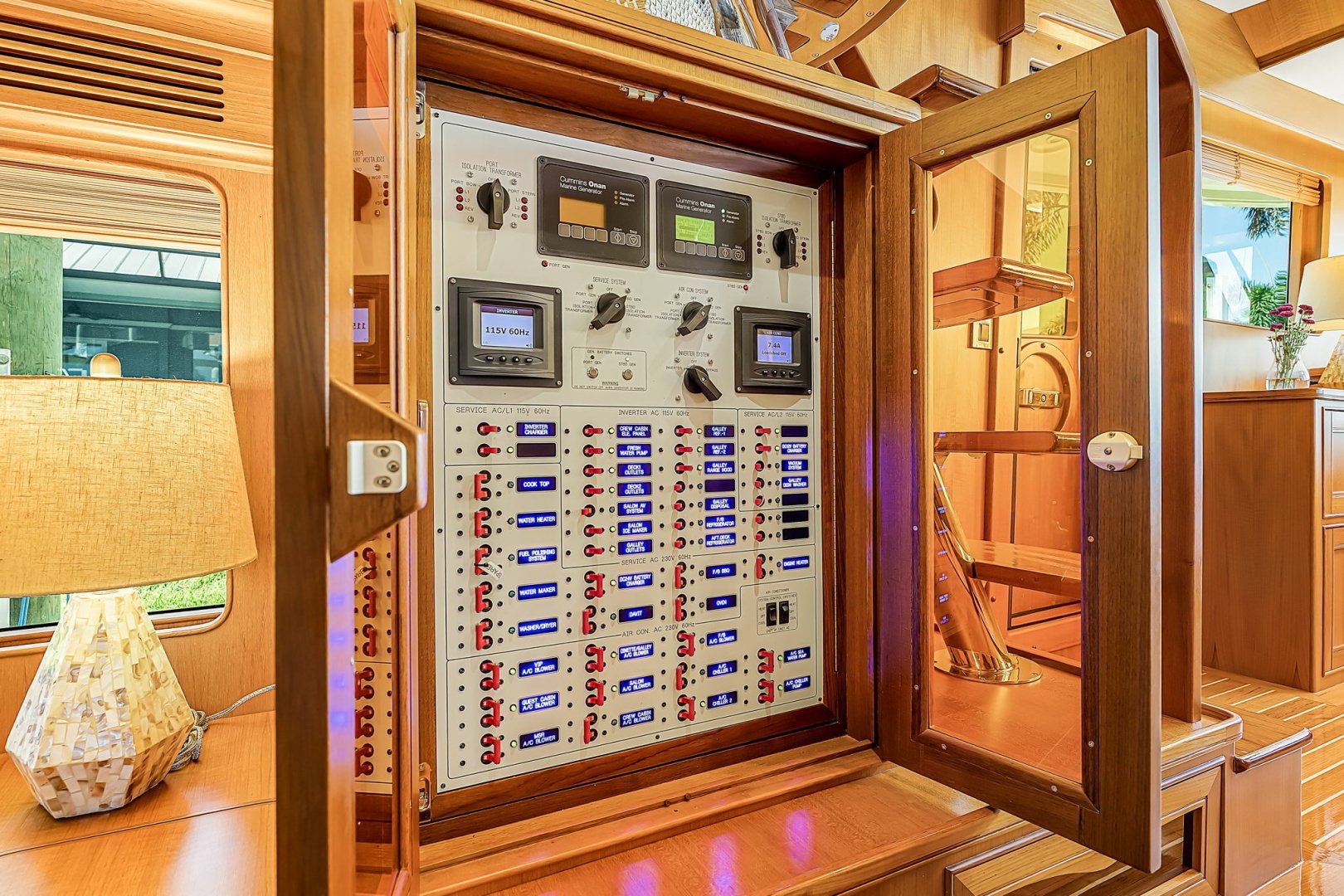
Upgraded twin 17 KW Onan generators in custom sound boxes and mounted forward in the engine room provide redundant electrical power at sea (each generator will independently carry the entire vessel's electrical load).
The dual, redundant, and supplementary water chillers and the start/finish of the circulating cold/hot water closed loop are here in the sound insulated machinery area keeping unwelcomed noises from waking guests in the middle of the night. The Naiad stabilizer hydraulic system is also found here in the engine room.
The fuel tank is located at the vessel's center of gravity which translates into no requirement of fuel management for trim or ballast, allowing all supply and return valves to remain open unless equipment isolation is desired. Fuel levels can be checked via sight tube mounted up against the fuel tank on the forward part of the engine room where it is easily accessed and viewed. Aft are the upgraded Seatorqe oil filled shaft systems for each shaft which greatly reduce friction, increase overall performance and reduce vibration contributing to the Marlow Explorer 's reputation for a "smooth ride." Stainless steel engine beds atop carbon fiber stringers support the engines on soft motor mounts that reduce vibrations transmitted to the boat from the engine. The thrust plate absorbs the forward thrust and transmit it smoothly to the hull through the carbon fiber stringers.
A separate pump room is located below the forward berthing compartment with access from the companionway. This space contains the fresh water and drinking water filters and pumps, redundant water pump and water distribution manifold.
- Twin Caterpillar C18 1150hp Engines (2550 hours) with full service just completed
- Twin 17kW Onan generators in custom sound shields (1290 hours) with full service just completed
- Yacht Controller
- 950 GPD Sea Recovery Watermaker
- Outback inverter and charger
- Centaur 24V 60AMP Charger
- Centaur 12V 40AMP Charger
- Two Charles lso Systems
- Lewmar Bow Thruster (20HP)
- Lewmar Stern Thruster (20HP)
- 2 Forward and 2 Aft 50 Amp Shore Power inlets- All with Glendenning Cable masters
- Backlighted electrical Panels
- Carbon Monoxide detectors in all berthing spaces
- Seatorqe oil filled shaft system with thrust plate
- Soft Motor Mounts
- Two Cross-Connected Sea Chest Sea Water Intakes with cleanouts
- FRP Fuel Tank (1500 gallons) with sump and cleanout
- Fuel Manffold and proprietary Sight Gauge
- Dual Racor fuel filters with pressure gages for each engine and generator
- Fire Suppressant System
- Engine Room Lead/Foam Sound and Heat Insulation System
- High Volume Engine Room Blowers
- Color Coded Piping
- Polished Stainless-Steel Engine beds with carbon fiber stringers
- Fuel Manlfold and proprietary Sight Gauge
- Dual Racor fuel filters with pressure guages for each engine and generator
- Fire Suppressant System
- Engine Room Lead/Foam Sound and Heat Insulation System
- High Volume Engine Room Blowers
- Color Coded Piping
- Polished Stainless-Steel Engine beds with carbon fiber stringers
- Gel coated bilges
- Oil change system
- LED Engine Room Lighting
- Common Drainage System from Bow to Stern collects deck drain, scupper and sump discharges
- Underwater Exhaust
- AGM Batteries
- Air Conditioned Engine Room and Crew Quarters
- Morse Electronic controls
- Naiad 252 Model Stabilizers